Tuesday, September 17, 2013

Reading cloth - Reading my mom's and my old kimono :)

I tried reading the fabric that is used in my mom's kimono. 
My mom wearing one of her kimono's when she was twenty years old

here are two kimonos


So my mom told me that in her young day's there were no department stores that would be selling kimonos. My mom's family was very traditional about the culture.They used to have this traditional japanese tailor in her hometown in japan ( called kumoto) to come and stitch their kimono's. She said back in those days the kimonos were completely hand made and hand stitched. The tailors would come to her home with the different variety of kimono fabrics. They would order the fabrics all the way from kyoto. At their house the tailor would try placing each fabric on everyone to check which one is suitable and then he would get it personally stitched for my mom her her family members.
She said that the name of the tailoring place as called Izutsuya Kohichi.
They were a family that was making traditional kimonos for generations in my mom's small hometown.
I tried researching on the tailor to see if I could find it but I unfortunately was not able to . 
So I asked my mom what the type of fabric is called and what style. 
She said the fabrics name is Chirimen and the type is Yuzen and Nishijin ori. So I did a bit of research and I was able to find some sort of link with the information.

Firstly : 
Chirimen Fabric  : Chirimen fabric is a thick, heavy silk crepe, a crinkled fabric made by the weft threads being kept tighter than the warp threads during the weaving process. Weft threads are twisted as they are woven, resulting in a uneven texture.
This weaving technique was developed in Japan over 500 years ago. Threads may be dyed before weaving, or the fabric can be dyed using various techniques after weaving.Chirimen fabric drapes beautifully, and it is difficult to crease. Therefore it is very popular for making kimonos.
Yuzen technique :Yuzen dyed fabric is used for kimono and obi sashes. Its motifs feature themes such as seasonal birds, trees, and flowers, using designs similar in style to those in traditional Japanese painting. The beauty of nature is expressed on white fabric. Kyo-Yuzenhas two dyeing styles: Tegaki-Yuzen, hand-painting, and Kata-Yuzen, stencil-dyeing. Hand-painting techniques were originally developed by Yuzensai Miyazaki in Kyoto in the middle of 17th century, therefore, the artform came to be called Yuzen. After that, stencil-dyeing techniques were developed by Jisuke Hirose in Kyoto in 19th century.
Nishijin Ori: Nishijin-ori woven textiles are widely used in the production of kimono and obi sashes. The weaving industry in Kyoto originated between the 5th and 6th centuries. It prospered with government-operated factories following the construction of the Heian Capital in 794. The name Nishijin came from the Nishijindistrict in Kyoto, where many weavers established their workshops after the end of Onin War (1467–1477). The richly decorative brocades were used for clothing for the Imperial Court and Buddhist and Shinto priests. Based on the design sketch, the dyed silk yarn is woven to produce the textiles which have elaborate patterns. Nishijin-ori has a wide variety of styles, such as gold brocade, damask, figured satin, and velvet. Today, it is said that there are no textiles that Nishijin weavers cannot weave.

I found the link between the types of technique and the place. My mom had said that her fabric was ordered from KYOTO and when I looked into the technique, I was able to find out that it originated in Kyoto itself! :) She said these fabrics were not available in her hometown at her point and that now majority of the reasonably priced kimonos and the casual ones are all machine made. It was honestly pretty cool to hear about this, These kimono's were lying at home for a very long time and I never knew about this. Finding out that she got the fabric specially from the traditional and only place that made it was just so cool and amazing to hear!
Even understanding the whole process from the making to even the buying and tailoring part is nothing like our time now. 

Here is one of my kimono's that i had worn till the age of 7.
My mom told me that she got this kimono for me when I was 3 years old for the traditional japanese festival Shi-go-san which means 3,5,7 . She explained to me that when a child is born, It's tradition to buy a kimono that is specific to this festive tradition.When the child turns three they go to the shrine with their child dressed in this kimono and thank god and for his blessing. Where you buy a special kimono made for the length of a three year old girl child and it's made in such a way that the kimono can be lengthened when the girl turns 5 and next again in 7. The kimono's bottom edge is folded and stitched so that it can be unstitched according to the girls height at her age of 5 and 7. It was just a way of marking the milestones of our life.  :) 

Khadi - A way of Life..

"We cannot claim to have understood the meaning of swaraj till khadi becomes as universal as currency."
(Navajivan, 12-3-1922; 23:77)


 Khadi is an Indian fabric. Khadi is also known by another name Khaddar. It is made by spinning the threads on an instrument known as Charkha. During pre-independence era the movement of Khadi manufacturing gained momentum under the guidance of father of nation Mahatma Gandhi. This movement of Khadi manufacturing and wearing started as to discourage the Indians from wearing of foreign clothes. As in all cases, there were believers and non believers. Those that did not believe in wearing or in Khadi were those that were supporting the English rule.
For Indians, Khadi was never just a cloth and will never be. It was a whole movement started by the father of our nation, Mohandas Karamchand Gandhi. The Khadi movement was not a revolt. It was more of an ideology, and idea that Indians could be self reliant and free from the costly goods that the British were selling to us. The British had a funny way of production. They would extract the raw materials, (in this case, cotton) from India at a really very cheap price and export them to Britain where they were woven to make clothes. These clothes were then brought back to India to be sold at hefty prices. So, the Khadi movement basically aimed at boycotting foreign goods and promoting Indian goods. Gandhi began promoting Indian goods, especially cloth as it is something that gives a person an identity, thereby improving India’s economy, thus making Khadi an integral part and icon of the Swadeshi movement. It symbolized the political ideas and independence itself.
Gandhi saw it as the end of dependency on foreign materials (symbolizing foreign rule) and thus giving a first lesson or real independence. Gandhi also felt that in a county where manual labor was looked down upon, it was an occupation to bring high and low, rich and poor together, to show them the dignity of hand-labor. He asked not only of those in need, but of every person to do spinning at least about one hour per day as sacrifice to his county, as duty towards the poor. He hoped for a certain bond of unity between the classes and masses by bridging the gap with a common occupation, and he saw great social value in hand-spinning. And as discussed in class with Ravindra, hand spinning can also be very meditative. It gives a person time for reflection. As Gandhi mentioned in Gandhi’s Khadi “when your wife gets angry, just spin”.  It was for economic, cultural and social reasons and not merely political that Gandhi established the Khadi Movement. He expanded the idea from helping the poor individual to self-reliance of whole villages...Thus Khadi was not merely a piece of cloth but it became a way of life.


Khadi cloth, relating it to the buddhist economy

We did a reading on buddhist economics last class. This made us really understand more about khadi cloth as we felt like the ideas of Buddhist economics really linked together, The only difference between them is that the Buddhist economy is against women working as they are meant to take care of their children and raise them .
The buddhist economics basically followed almost all the principles and ideas of the buddhist religion alone.
Buddhist economics :
Doing work of labour is about getting a better personality, delivering a finished work .
It is considered to be more humanitarian if you are very committed and loyal to your work.
They believe that if you work hard and do good in your work, it will pay off by giving you a better life in all your  personal needs like nourishing your body. This is very similar to the idea of Buddhism alone where they believe that if you do good, all the good will be returned to you someday.
We also related our reading and did a comparative to modern  economics. for modern economists, work is about how much you gain out of it or earn out of it. Buddhist economy believes in doing well with work or earning but  their main aim is about liberating yourself. They believe in living the simple way of life  without thinking about the benefits of really doing something.
Buddhist economics also takes huge concerns about being cautious about every move they make, even regarding things about the environmental issues. They believe in being very humble.Their aim is to be happy or content by minimum usage of things.
Modern economics encourage consumption, they believe that the more the consumption the better as it would increase the demand for things therefore increasing the production of the goods and earning more of an income.
You can see the impact the ideas of the religion alone has on the bud hist economy.
I feel like the ideas about khadi regarding the movement it created is very similar to that of the ideas in the buddhist economy.
Khadi cloth played a huge role in india during the time before independence and post it.
Khadi helped unite people in india.
Gandhi needed a way to unite a huge nation like india through a medium and khadi was the medium in which everyone could relate to and work with.
People started weaving their own clothes through khadi. Khadi cloth gave the people an identity. Although khadi also helped poeple under poverty and helped them in self sustainability,
More than anything, it was about having a connection with the idea of khadi.

SPEAKING TO PEOPLE ABOUT KHADI :
I tried asking my parents about khadi and what they felt about it but unfortunately they both could not relate to it much.
My mom is originally japanese and she works with japanese people for tourism so she related herself at a foreigners point of view and said that khadi seems to represent india or gives out an image of india. So there are apparently official stores my mom knows of that sell khadi and it fascinates her and people to buy them. So in her point of view khadi is nothing more than a fabric that's very commercial now.

I spoke to my friend Hansa's mom - Anuradha grover.
She loves khadi fabric, She was mainly influenced by khadi because of her father. He felt like he was very attatched to the fabric as it represented india. He felt that it was important to still respect the good changes or impact that this fabric had brought to the country. So he felt that it was important to wear khadi cloth for the kind of identity it has. Wearing khadi made him proud.
whereas, Anuradha aunty felt like khadi was just really comfortable to wear. Khadi started becoming a trend when she was studying in college and they were being sold in different bright and fun colours to adjust to the the taste of youngsters. So khadi was a very popular fabric in everyone's outfit.

Tuesday, September 10, 2013

Traditional cloth

Traditional cloth
Clothing in India varies from:


 region to region depending on the ethnicity, geography, climate and cultural traditions of the people of that region
Community

•The Chhipa community has been hand block printing for about 350 years,
•The Bagru Chhipa community migrated from Jaipur and settled in the Bagru area near the Sanjaria River because it provided the necessary water for printing and chhikni mitti, an important ingredient in Dabu mud.

bagru

• Bagru, a small village town in Rajasthan is situated at a distance of 32ksm east of Jaipur.
• It is known for its traditional processed of hand block printing of textile

cloth

•soft and extraordinary cloth were  selective cotton as the raw material to enhance the quality of our product.
•Apart from this they experiment with other kinds of fabric also.
                  motives
•The designs are based on traditional patterns of our novel culture.

•Bagru prints are characterized by circular designs, as well as linear and floral patterns.
                      colour

•Bagru prints are done with natural colours.
•Bagru prints, the colors are picked carefully. Each has a separate significance.
• For instance, red is the color of love, yellow of spring, indigo of Lord Krishna, and saffron of the yogi (seer)
            blocks

•The wooden blocks that are used are made of teak wood.
           Process 

•Scouring-The fabric that comes from mills of handloom sector
•       Tannin- locally called ‘Peela Karana’ ‘Harda’Washed fabric is treated with myrobalan (harda) which contains tannic acid.
•Printing (mordanting)- locally called ‘chapai’
•Ageing-locally called ‘Sukhai’
•Washing- locally called ‘Dhulai’
•Dyeing (fixing of color) - locally called ‘Ghan Rangai’
Sun-bleaching- locally called ‘
Tapai’
       Changes
•The traditional ‘motifs’ of Bagru have however under gone change over the years. The entire population of ‘chhipas’ which were earlier engaged in production of all local varieties of printed fabrics mostly of ‘fadats,indigo fabric’, ‘angochha’ (small towel), ‘bichhauni’ (bed spread), rajai (quilt) are now engaged in production of sophisticated ‘ kaftans’ ‘wraparounds’ (skirts), ‘midis’ etc.
•Natural dyes have now been largely replaced by chemical dyes.


day 2

 Day two
On the second day we were asked to take a garment which we liked the most, we looked at a few textiles of different people and identified it and learned the names of few like maheshwari cloth which contains a cotton warp and silk weft. We understood from were does the cloth come from by looking at the motives made on it who produces it, How does the cloth signify the region, for what is the cloth made for. We also questioned on why are these motives printed on the cloth? Thought this is done in order to revive the culture of a particular place so that the future generation  gets an understanding of the object. And we also came up with a conclusion that different fabrics around the world have different motives depending on each country culture. We also understood that  cloth talk about status of a person like for instance if we see a person wearing a silk sari or a garment which is highly decorated we understand that the person comes from a higher sector of the society or the rich class , we noticed  poor people generally wear ticker cotton because its cheap , by this understanding of cloth or fabric we come back to the identity of a person or judging a person by what he or she wears.
We also questioned things like “were did the sary concept come from? And we understood that no one exactly knows from were did the sary come from we just know that tribal people used it as a drab to cover themselves , and then we spoke about how many  ways are there to drab a sary and how many styles are used by people , we questions like why don’t we use the tribal way draping the sary and why are these tradition dying ,  I feel the tradition is dying because of modernity and the newer generations prefer to  follow the western trend rather then following their own culture .even if these styles of different cultures are noticed it is because of film ,media and different cultural events. Later on we were given different textiles and we were only given the country name and we were asked to research each and everything on it .we had got a  cloth from Yemen . we looked at it in a different way because of our learning’s of the previous classes,
 I liked class a lot because we got an understanding of how to read a cloth by looking at varies aspects.  understanding of the cloth in accordance to the country it comes from , what colors they use , what motives they use all depends on the cultural background of the country or the place it comes from. We also understood how different people read the same cloth in a different way.the discussion in class helped us more in our research in understanding our cloth.


Monday, September 9, 2013

Bandhani - Indian tye and dye

WHAT?
The art of Bandhani is highly skilled process. The technique involves dyeing a fabric
which is tied tightly with a thread at several points,thus producing a variety of patterns
like Leheriya, Mothra, Ekdali and Shikari depending on the manner in which the cloth is
tied.


WHEN?
Different forms of tie and dye have been practiced in India. Indian Bandhani, a
traditional form of tie and dye, began about 5000 years ago. Also known as Bandhani
and Bandhej, it is the oldest tie and dye tradition that is still practiced.

Ancient artists discovered that some dyes dissolved and gave their
color readily to water, forming a solution which was easily absorbed by the fabric. Herbs
and plants like turmeric and indigo were crushed to a fine powder and dissolved in
waters that cotton material could be dyed into deep colors. These colors have been
used in India since ancient times and are considered to be the origin of the art of dyeing.
Throughout Asia, India and the Far East, traders packed tie and dye cloths as part of
their merchandise.

Bandhani was introduced in Jamnagar when the city was founded 400 years ago.
Bandhani fabrics reign supreme in Rajasthan and Gujarat which are home to an
astounding variety of traditional crafts. Century‐old skills continue to produce some of
the most artistic and exciting wares in these two states and are popular all over the
world.

WHERE?
The art of Bandhani is practiced widely in Rajasthan, with Barmer,Jaipur, Sikar, Jodhpur,
Pali Udaipur, Nathdwara and Bikaner being the main centers. Bandhani comes in a
variety of designs, colors and motifs and these variations are region‐specific. Each
district has its own distinct method of Bandhani which makes the pattern recognizable
and gives it a different name.

The centers of tie and dye fabrics in Gujarat are Jamnagar in Saurashtra (the water in
this area brings out the brightest red while dyeing) and Ahmedabad. The craftsmen
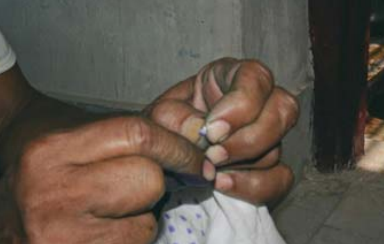
from Rajasthan are easily recognized because they grow the nail of their little finger or
wear a small metal ring with a point to facilitate the lifting of cloth for tying. The
Gujarati craftsmen, however, prefer to work without these aids as no damage is done to
the cloth when one works with bare hands.
The Bandhani regions are
Rajasthan -Marwar‐‐Jodhpur,Mewar‐‐Udaipur,Shekhawati‐‐Sikar,Jhunjhunu, Churu
Gujarat -Jamnagar, Bhuj, Mandavi
Uttar Pradesh -Farukabad

It is difficult to trace the origins of this craft to any particular area. According to some
references it first developed in Jaipur in the form of Leheriya. But it is also widely
believed that it was brought to Kutch from Sindh by Muslim Khatris who are still the
largest community involved in the craft.


RAW MATERIAL :
                                 The fabrics used for Bandhani are muslin, handloom, silk or voile.Various synthetic fabrics are also highly in demand.For tying knots mostly synthetic thread is used on the fabric.
Traditionally vegetable dyes were used but today chemical dyes are becoming very popular.

HOW?

PROCESS :The process, though relatively simple, is very time‐consuming. The tying of the fabric is
mostly carried out by women or young girls.
The material generally used is a thin loosely woven silk known as georgette or a cotton
known as malmal

The area of the fabric to be dyed is outlined using fugitive colors. Then a clear thin sheet
of plastic, which has been pierced with pin holes, is kept over this area of the fabric and
using fugitive colours an imprint of the desired pattern is transferred onto the fabric.


                      After tying the knots the fabric is thoroughly washed to remove the imprint.
           The cloth is then dipped in napthol for five minutes and dyed in yellow or another light
           color for two minutes.


Next it is rinsed,squeezed, dried and then tied again and dipped in a darker color. This is
kept for three to four hours(without opening the knots)to allow the color to soak in.

After the last dyeing process has been completed the fabric is washed and if necessary,
starched. After the fabric is dried, its folds are pulled apart in a particular way releasing
the knots and revealing their pattern. The result is a usually deep colored cloth with dots
of various colours forming a pattern.


       Very elaborate motifs are made, in tie and dye work. These include flowers, creepers,
       bells and jalas. Knots are placed in clusters each with a different name, for example, a
        single dot is called Ekdali, three knots is called Trikunti and four knots is called
           Chaubundi. Such clusters are worked intricately into patterns such as Shikargah
                      (mountain‐like), Jaaldar(web‐like), Beldaar(vine‐like) etc.


     Rajasthan is well known for its Leheriya pattern or pattern of waves, which symbolizes
      water waves.Only two colors are used which alternate each other in a pattern of stripes
    arranged diagonally.Originally,the two colors used were the auspicious colors of yellow
   and red. Turbans, odhnis and saris with the leheriya pattern are liked and worn all
   around year.


Showing leheriya tied diagonally being dipped
                                 In Bandhani, different colors convey different meanings.
  While red represents a bride, a yellow background suggests a lady has become a mother recently.

                                         
MARKET :
                     The bulk of the market is domestic with the main market being in Gujarat where most women wear Bandhani saris, shawls or odhnis. The odhnis are also decorated with mirrors, gota and

tassels to give it a richer and more decorative look.

Today, designers are using Bandhani fabric for contemporary clothing and it is being used to represent India in the international circuit. New colors and patterns are being used to cater to a wider market, though traditional red, yellow and pink still continue to be the all‐time favorites!


Bibliography
1. http://www.indianwomenonline.com/womenhome/indianmosaic/textiles/Bandh
ani/Bandhani.asp
2. www.greatvistachemicals.com
3. http://www.pburch.net/dyeing/fiberreactive.shtml

4. http://www.pburch.net/dyeing/FAQ/history_tiedye.shtml


PAITHANI...is it a sari or a shalu???


1) Saree: 
It is essentially a saree or a textile that is draped around waist in India by women..A sari or saree is a strip of unstitched cloth, worn by women, ranging from four to nine yards in length that is draped over the body in various styles which is native to the Indian Subcontinent In olden days which we link to our culture and tradition, it used to be whole 9 yards even 11 yards


 Q: What was the role of women in India before 20th Century ?
A: Housewife-household work, Farm work and work related to care taking and raising family.

Elaboration:
 Imagine, for ladies, wear a shorts or jeans or salwar kurti and try running, going to well to fetch water, sitting in farm to pluck produce or sow seed, handling your kids and rest of work that a well organised family needs such as washing cloths and utensils in sitting position, cooking and feeding your baby. Now compare this with wearing a 6 yard saree that is used today.
For men, just compare it by wearing a Dhoti (essentially with the same style of 9 yard or Nauary) with your formal wear or even tight jeans.
In short, 9 yards saree and more importantly the way it was draped is more of a Science and utility than tradition. Go back to small towns or villages and you will see how comfortable and quick women there in all daily work in their 9 yard draping. We are humans who can collect memory and pass them forward and in doing so we name them according to the purpose. Saree is tradition but with reference to the living style of our previous generations.
Irrespective of geographical variation, it was more of less draped similarly. Few variation were again of its utility such as in coastal area, they were folded at knees and in Gujarat, draped around chest more appropriately. Details of each region will be discussed in my next post.
So, understanding the reason of 9 yard drape, its transition to 6 yard can be easily connected to dramatic changes in our civil society, more importantly in British ruled India. Domestic help, life in rather developed towns, concrete or stone houses, cooking gas, kerosene stoves, British style kitchens (standing) and table-chair-sofa culture changed many references to women of India. The role of women shrank to family life and social presence and thus the 9 yard drape quickly became inappropriate socially. A western influence of blouse or top and drape converted 9 yard into 6 yard simply because it was comfortable, appropriate-decent and yet very much Indian. Length was just matter of how much it required to drape accordingly. The distinction (even 50%+ India) is untouched by such transition which can been seen in our villages even today


SHALU: 
Shalu was a famous version of Paithani that became popular form of saree. Shalu has its origin from Varanasi or Banaras and even today Shalu is more referred to Banarasi. It is believed that Peshwa of Pune during their travel to Varanasi (mainly for expansion of Maratha Rule under Chhatrapati Shahu of Satara) brought this version to Maharashtra. Yeola which was prosperous weaving center of Paithani set up by Peshwa, assigned the job of weaving Shalu. It is probable origin of Shalu in Maharashtrian form of Paithani.
One prominent distinction between Paithani Saree and Shalu is its texture. While Paithani was weaved in thick silk or cotton, Shalu was weaved in very fine thin silk. Paithani is essentially a border and plain jari pallu with butti on base, Shalu had some motifs on border and more designed pallu. In contrast to Banarasi shalu, which had all base embellished with jari motifs. It was therefore not exactly shalu for which the term was commonly used. Till 1950's Paithani was mainly weaved in Paithan and Shalu were in Yeola. As liking of Shalu declined due to its simple non evolved form while other regional textile advanced and available across India, Yeola stopped making Shalu and switched to Paithani.
In appropriate terms, Paithani Shalu were nothing but fine Saree with design and not really comparable to the Shalu term which was used for Banarasi Sarees.

PAITHANI....


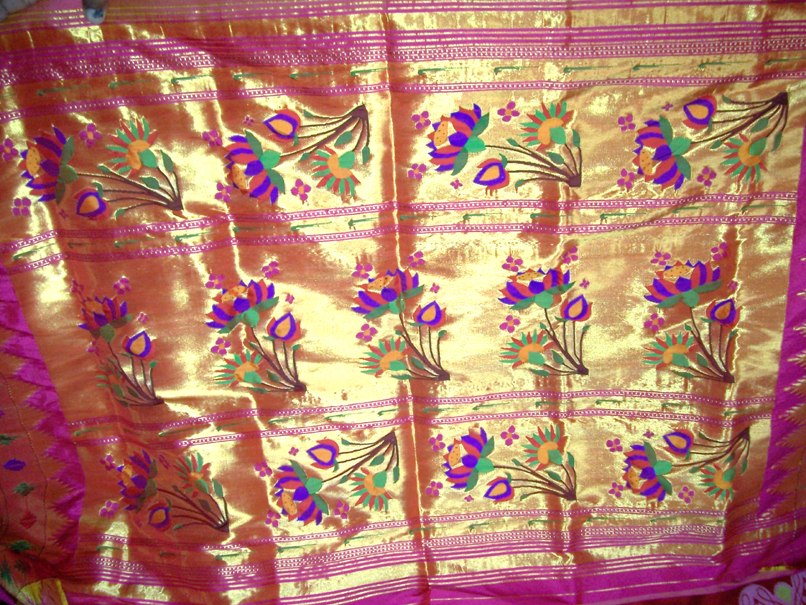
                                                 Indian culture has given birth to many exotic weaving traditions. Paithani is one such craft tradition which dates to 200 BC.Paithani sari is named after the Paithan town in Aurangabad Maharashtra state where the sari is woven by hand. Paithani Saris give a very elegant look with royalty and style.Paithani is a hand-woven sari in gorgeous colors and intricate designs, a paithani sari is treasured as a valuable possession in every Maharashtrian family.
                                                 Paithani carrying cultural legacy of Maharashtra have special meaning in life of women who forms pillar of every family and society. It is the only textile, which unite entire elements of life in the form of blessings and protection to the wearer. Made from natural silk or cotton with precious metal of gold and silver, it gives the Midas touch. Particularly, the motifs that set Paithani above all other traditional fabric bear special significance of true Indian philosophy of living in harmony with nature and its elements.

                                                 Bangle-Peacock motif (Bangadi-Mor), where bangle represent completeness of woman being sign of Saubhagya, Peacock, bird of paradise indicate beauty, royalty, wisdom, wholeness, dignity, love and believed to be a guardian. Peacock also carries sense of energy that comes from its renewal of feathers every year. Its asso­ci­ation with Goddess Sarswati rep­re­sents benevo­lence, patience, kind­ness, com­pas­sion, and luck. In Muniya or Tota-Maina motif parrot is symbolized. Parrot is sign of love and passion. Red beak represents the red earth before the rain or unfulfilled desire and the green feathers represent the green earth after the rains or fulfilled desire, full of joy. Lotus or Kamal Pushpa is motif of close resemblance with Ajanta Caves located in Aurangabad, Maharashtra. It is the sign of rebirth, it closes in the evening and falls to the water, but in the morning, it opens lifting above the surface. It also represents essence of life apart from royalty, beauty and purity. Coconut border (Narali) was most common Paithani border until the end of 19th century. Coconut also known as Sriphal is fruit of gods. It symbolises complete usefulness, selfless service, prosperity and generosity. Coconut tree or Kalpvirshka is termed in Hindu mythology the tree that grants all wishes. Adding sense of beauty and aesthetics more motifs such as Asavali, geometrical figures, Amarvell and flowering wine were incorporated with passage of time.


                                                 Each Paithani is a dedicated and painstaking work of an artisan who incorporates his soul and heart in weaving every thread that binds all elements of life in the ‘one’ without which it is just another fabric. Passing love and care from mother to daughter for generations, Paithani achieved its place of most precious heirloom of every woman.